


When Should You Start Pelvic Floor Physiotherapy Before Prostatectomy?

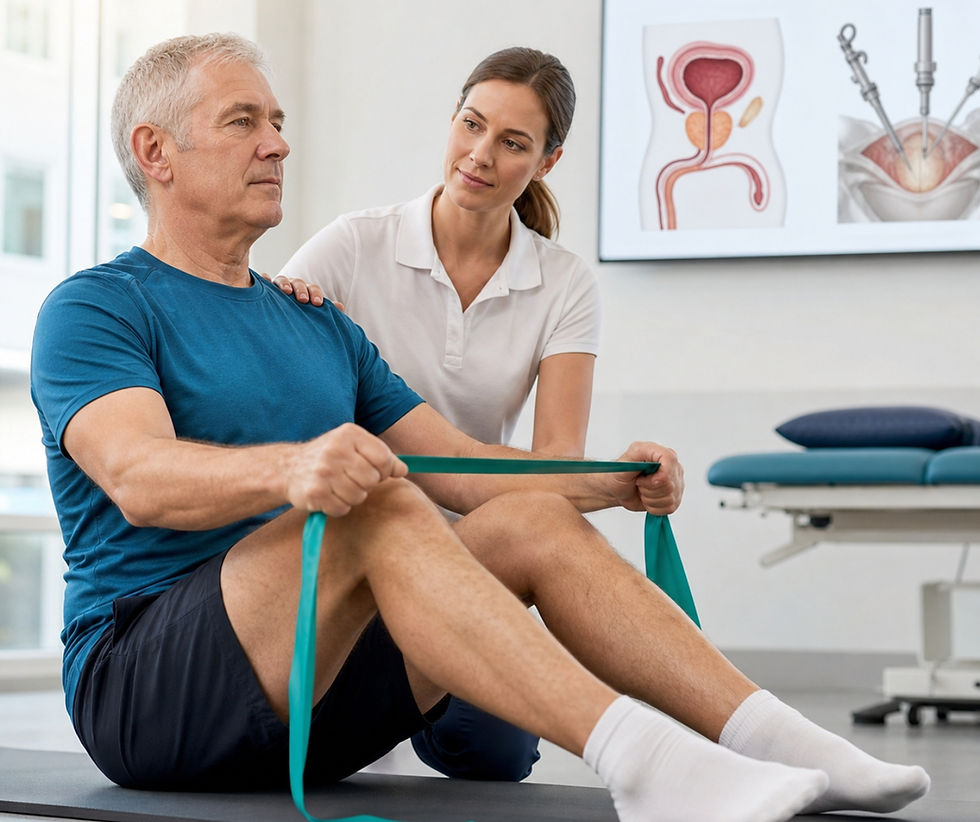
If you are preparing for prostate surgery, you may have heard that pelvic floor exercises can be an important part of recovery.
The next question is usually:
“When should I actually start?”
Some men are referred for physiotherapy months before surgery. Others only hear about prehabilitation a few weeks beforehand. Some are scheduled for surgery quite quickly and wonder whether there is still enough time to make physiotherapy worthwhile.
From a physiotherapist’s perspective, the ideal time to start is usually before surgery rather than after it. However, the exact timing often raises more questions than answers.
Why Start Physiotherapy Before Surgery?
Traditionally, rehabilitation was something that happened after an operation.
In recent years, there has been increasing interest in prehabilitation, which involves preparing patients before surgery to help support recovery afterwards. Before prostatectomy, this often includes pelvic floor muscle training, education, and physical preparation.
The goal is not to “treat” a problem before it happens.
Instead, pre-operative physiotherapy aims to help patients:
Learn pelvic floor exercises correctly
Understand recovery expectations
Improve confidence before surgery
Establish a rehabilitation routine
Build awareness of pelvic floor function
Prepare for bladder control changes after surgery
Many men find that recovery feels less overwhelming when these foundations are established beforehand.
If you are preparing for prostate surgery, a men’s health physiotherapy assessment can help you understand what to practise, how to do it correctly, and when to progress.
Is There an Ideal Timeframe?
In an ideal world, physiotherapy would begin several weeks before surgery.
This allows enough time to:
Learn the correct technique
Practise consistently
Receive feedback
Ask questions
Become comfortable with the exercises
Understand what to expect immediately after surgery
Learning a new movement pattern takes time. Most men have never consciously used their pelvic floor muscles before, so becoming familiar with them before surgery can be valuable.
That said, there is rarely a “perfect” window.
What If Surgery Is Only a Few Weeks Away?
A common concern is:
“Have I left it too late?”
In most cases, no, absolutely not. You can start any time.
Even when surgery is approaching, a pre-operative physiotherapy assessment can still be beneficial.
You may still have time to:
Learn proper pelvic floor activation
Understand common rehabilitation principles
Review bladder and bowel habits
Prepare questions about recovery
Develop a post-operative plan
Learn what to avoid in the early recovery period
While more preparation time is generally preferable, some preparation is often better than none.
If your surgery date is close, the focus may be on simple, practical education rather than a long exercise programme. This can still make a meaningful difference to how confident and prepared you feel going into surgery.
What If Surgery Is Months Away?
If surgery has been scheduled well in advance, there may be an opportunity to take a more structured approach.
This can allow time to focus on:
Pelvic floor awareness
Technique refinement
General physical activity
Building confidence
Understanding recovery expectations
Developing a realistic routine
Importantly, this does not mean spending months performing hundreds of pelvic floor contractions every day.
The objective is usually education, preparation, and consistency rather than intensity. More exercises are not always better. The right exercises, performed correctly and progressed appropriately, are usually more useful than doing too much too soon.
Why Learning Earlier Can Be Helpful
One of the biggest advantages of starting before surgery is that you are learning when you feel physically well.
After surgery, you may be managing:
Fatigue
Activity restrictions
Recovery concerns
New bladder symptoms
Changes in routine
Worry about what is “normal”
Learning pelvic floor exercises during this period can be more challenging than learning them beforehand.
Many physiotherapists therefore view pre-operative appointments as an opportunity to remove uncertainty before recovery begins.
What Happens If You Wait Until After Surgery?
Many men do exactly that.
Sometimes recovery progresses well regardless. However, one common challenge is uncertainty about whether pelvic floor exercises are being performed correctly.
Questions such as:
“Am I using the right muscles?”
“How hard should I squeeze?”
“Am I doing enough?”
“Why does this not feel like I expected?”
“Should I keep going if I am leaking?”
Are often easier to address before surgery rather than after it.
Prehabilitation provides an opportunity to build confidence before those questions become part of recovery.
If urinary leakage becomes a concern after surgery, physiotherapy may also support bladder control through education, pelvic floor training, and individualised rehabilitation. You can read more about this on our urinary incontinence treatment page.
Does Earlier Always Mean Better?

Not necessarily.
Starting six months before surgery is not automatically better than starting six weeks beforehand.
The value of physiotherapy comes less from the length of time and more from:
Learning the correct technique
Understanding the purpose of the exercises
Receiving appropriate feedback
Developing confidence with the programme
Knowing how to restart safely after surgery
Good preparation is usually more important than simply starting as early as possible.
What If You Are Unsure Whether You Are Doing the Exercises Correctly?
This is one of the strongest reasons to seek pre-operative physiotherapy.
Many men unintentionally:
Hold their breath
Tighten their buttocks
Overuse their abdominal muscles
Push down instead of lifting the pelvic floor
Perform exercises too forcefully
Misidentify the pelvic floor entirely
A physiotherapy assessment can help identify and correct these issues before surgery takes place.
At PhysioMatters, we use Real Time Ultrasound Imagery (RTUS) to view your muscle action on screen in live action.
This provides visual feedback, is pain free, and is included in the cost of your session.
For many patients, this reassurance is one of the most valuable parts of prehabilitation.
Signs It Is Worth Booking an Assessment
You may benefit from arranging a pre-operative assessment if:
Your prostate surgery has already been scheduled
You have been advised to start pelvic floor exercises
You are unsure whether you are using the correct muscles
You want clearer expectations about recovery
You prefer to be proactive rather than reactive
You would like an individualised plan before surgery
You are worried about bladder control after prostatectomy
Importantly, you do not need to wait for symptoms or problems to occur before seeking physiotherapy.
You can also review what happens during an appointment on our what to expect page.
The Best Time Is Usually Before Recovery Begins
Many men spend a lot of time wondering whether they should start physiotherapy now or wait until after surgery.
In most cases, the better question is:
“Would I rather learn these skills before recovery starts, or while I am already recovering?”
Pre-operative physiotherapy provides an opportunity to build awareness, develop confidence, and better understand what rehabilitation may involve before surgery takes place.
At PhysioMatters Singapore, we help men prepare for prostate surgery through personalised prehabilitation assessments, pelvic floor education, RTUS imagery, and recovery planning designed to help them feel informed and confident before the operation begins.
Contact us today!
References
Mungovan SF, Carlsson SV, Gass GC, Graham PL, Sandhu JS, Akin O, et al. Preoperative Exercise Interventions to Optimize Continence Outcomes Following Radical Prostatectomy. 2021. https://pmc.ncbi.nlm.nih.gov/articles/PMC8030653/
Zhou L, Chen Y, Yuan X, Zeng L, Zhu J, Zheng J. Preoperative Pelvic Floor Muscle Exercise for Continence After Radical Prostatectomy: A Systematic Review and Meta-analysis. 2023. https://www.frontiersin.org/journals/public-health/articles/10.3389/fpubh.2023.1186067/full
Terek-Derszniak M, Gąsior-Perczak D, Biskup M, et al. Continence Recovery After Radical Prostatectomy: Personalized Rehabilitation and Predictors of Treatment Outcome. 2025. https://www.mdpi.com/2075-4418/15/22/2881
Contact Information
Email: hello@physiomatters.com.sg
Tele: +65 9352 9067
Address: 360 Orchard Road #10-07 International Building, 238869


Comments